
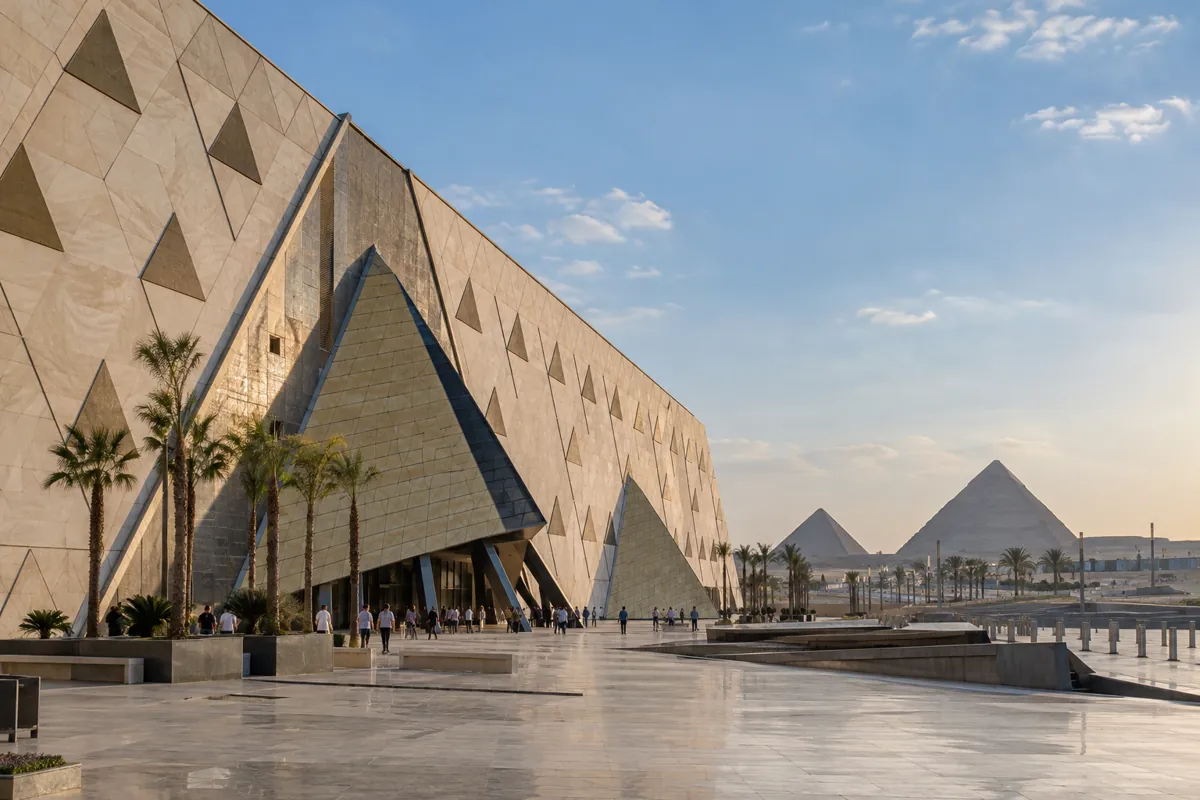
The Grand Egyptian Museum is an archaeological destination near the Giza Pyramids. Plan around your interests, the available galleries and current admission, and distinguish it from the museums in Tahrir and Fustat.
The complete Tutankhamun collection: Tutankhamun is a central collection at the museum; check the current ticket description and available galleries rather than assuming every object is visible at all times.
The colossal Ramesses II statue: greets you in the museum's main atrium, standing over 11 meters tall — the first thing you'll see when you enter.
The Grand Staircase: A monumental architectural route displaying large statues and other objects. Its arrangement should not be confused with the chronological scope of the main galleries.
Proximity to the Pyramids: The nearby locations can support a combined day when time and energy allow, with separate admission and entry arrangements.
Booking: Use the museum’s official visit information and current ticketing links, checking visitor category and entry window before confirming your day.
If you want to combine the Grand Egyptian Museum with the Pyramids in a single day trip, a private car with a driver gives you the flexibility to move between the two sites within the agreed route, time and waiting arrangements.
What kind of visit do you want at the Grand Egyptian Museum?
The Grand Egyptian Museum, often shortened to GEM, rewards a plan based on interests rather than a race through every room. Some visitors want to concentrate on Tutankhamun, others on royal sculpture or the relationship between objects and daily life. Before buying tickets, choose the two or three themes you most want to understand. That gives the visit a purpose and helps you decide whether to give the museum its own day or combine a shorter selection with another Giza stop.
The museum is near the Giza Pyramids, but it is a separate destination with its own admission and visitor arrangements. It is also different from the Egyptian Museum in Tahrir and the National Museum of Egyptian Civilization in Fustat. Check the name and location on your ticket, booking message and transport request. Simply asking for the Egyptian museum can send a visitor to the wrong institution, especially when different members of a group are making the reservations.
Understand the objects instead of collecting photographs
A useful way to look at an ancient object is to ask four questions: who used it, what material was chosen, what it was intended to do and how the museum knows its context. A royal statue and a small personal object communicate different kinds of evidence. The first can express authority through scale and posture; the second can reveal workmanship, personal use or the way a material was valued. Read the label before deciding that a famous or golden object is automatically the most informative one.
Try comparing two objects with a shared function rather than photographing every display in sequence. Notice how a change in material, size or decoration changes the impression. When an object is connected with burial, distinguish the original person's use of it from its place in funerary preparation. This turns a visit into a set of understandable connections and works well for families: each person can choose one object and explain what question it raises.
The Grand Hall and Grand Staircase are part of the visit
The monumental arrival spaces should not be treated only as a route to the galleries. The colossal Ramesses II statue provides an introduction to the scale of royal representation, while the Grand Staircase brings large monuments into an architectural sequence. The official inauguration description identifies the staircase as a major element of the museum. Let its displays introduce questions that you can follow in the galleries instead of rushing past them to start an imaginary checklist.
An overview does not require climbing every step if that is unsuitable for your group. Ask the museum about the current accessible route and assistance arrangements before travelling. Explain the actual need, such as avoiding stairs, using a wheelchair or limiting walking, rather than asking only whether the building is accessible. A useful answer needs to cover arrival, movement between displays and the return to the collection point.
Make time for Tutankhamun without assuming everything is visible
Tutankhamun is a central reason many people visit GEM. His burial assemblage offers a way to think about royal identity, craftsmanship and funerary beliefs together. Instead of seeing the objects as unrelated treasures, follow the relationships between them: what was made to be worn, what represented power and what belonged to burial equipment. Keep the labels' distinction between an interpretation and an established identification, particularly where the purpose of an object is more complicated than its appearance suggests.
Check the museum's current ticket description for the galleries included on your chosen date. A general statement that a collection is housed at a museum does not mean every object is on display or every space is open at all times. Temporary work, special rules or operational changes can affect an individual visit. Avoid planning around a single photograph without verifying that the relevant display is currently accessible.
Tickets, opening hours and the difference between last entry and closing
Start with the museum's official visit information and follow its current ticketing links. Review your visitor category, date, entry window and the actual inclusions before payment. Keep the confirmation available offline. If a ticket category requires identification or proof of eligibility, prepare that document as well as the booking reference. A screenshot of a third-party advertisement is not a substitute for the issued ticket.
Do not confuse the wider complex's opening period with gallery hours or the final admission time. Arriving just before a sales cutoff leaves little room for security and a meaningful visit. Check the schedule for your particular day rather than reusing hours from a friend's earlier trip. Transport collection should be based on when you intend to finish, with time to leave the displays and reach the meeting point, not merely the building's published closing time.
Photography, bags and a comfortable route
Consult the museum's current visitor rules before packing camera equipment. Personal photography is subject to display-specific restrictions, and flash and equipment such as tripods are restricted. Read signs and follow staff directions in each area. Leave time to look without a screen: a detail that is difficult to photograph can still be the most interesting part of an object. Avoid blocking the display while the rest of the group waits.
Travel lightly and ask about storage if you will arrive with airport luggage. A large suitcase changes both transport requirements and the practicalities of museum entry; do not assume that anything fitting in the vehicle can accompany you through the galleries. Families should plan breaks and a sensible stopping point. Finishing a selected route while everyone remains interested is better than continuing until the last rooms become an exhausting blur.
Should you combine GEM and the Pyramids in one day?
It can be a reasonable plan when the group wants a focused museum selection and a defined plateau visit. It becomes less useful when every member has a long list of galleries, pyramid interiors, photographs and additional activities. List the priorities for each site and check separate ticket arrangements. Their geographic proximity does not merge security, entrances, internal walking or admission into a single visit.
For a combined day, decide which site has the least flexible commitment and build around it. A booked museum entry window or confirmed guide appointment needs to match the other site's actual opening arrangements. Leave a proper break instead of treating lunch as something that happens while moving. If the programme becomes too crowded, move a secondary stop to another day rather than shortening both main visits into hurried photographs.
Choose transport for the route you will actually follow
A hotel-to-museum transfer suits a visit with one clear destination, while an agreed car-and-driver period can suit GEM, the plateau and a return to a different address. Tell the operator about every planned stop and any luggage. Confirm the drop-off and collection arrangement, including how you will contact the driver after leaving the museum. A vehicle does not automatically include a qualified guide, admission or unlimited waiting.
General Limousine's confirmed day options are eight hours with up to 120 kilometres or twelve hours with up to 150 kilometres, normally beginning when the customer boards. Standard extra use is EGP 150 per hour and EGP 20 per kilometre; HiAce and Coaster use EGP 200 and EGP 25 respectively. An additional half-hour is charged as a full hour. Obtain the base quotation for the actual itinerary through car and driver hire; these allowances do not establish a universal museum-trip fare.
Questions that make the booking more useful
Is GEM the same as the museum in Tahrir Square?
No. Confirm the institution's full name and location before booking transport or admission. GEM is the Grand Egyptian Museum near Giza. A journey to Tahrir is a different destination, and one museum's ticket does not establish entry to the other.
Do I need to see every gallery for the visit to be worthwhile?
No. Choose a coherent selection that matches your interests and energy. Studying several related objects and understanding their context can be more rewarding than walking through many rooms without reading anything. A specialist guide can help build that selection if separately arranged.
Does a private driver act as the museum guide?
Do not assume that. Transport, guiding and admission are distinct services. If you want historical interpretation, request a guide explicitly and confirm the language, meeting point and scope. The driver manages the agreed vehicle journey; museum instructions still govern access and conduct.
Can I visit immediately after landing?
Only plan it with enough room for airport procedures, travel and luggage arrangements. Flight arrival time is not museum arrival time. If the journey or ticket window is too uncertain, a hotel stop or another visiting day can be more practical than risking a rushed visit.
Where can I plan the other half of a combined Giza day?
Use the Giza Pyramids and Sphinx guide to distinguish the plateau visit, optional interiors and transport. Then compare that outline with the museum route. Keeping the two plans explicit helps avoid buying time and services that do not fit together.