
The Citadel of Saladin is one of Cairo's most important historic and military landmarks, and also offers one of the best panoramic views over the entire city.
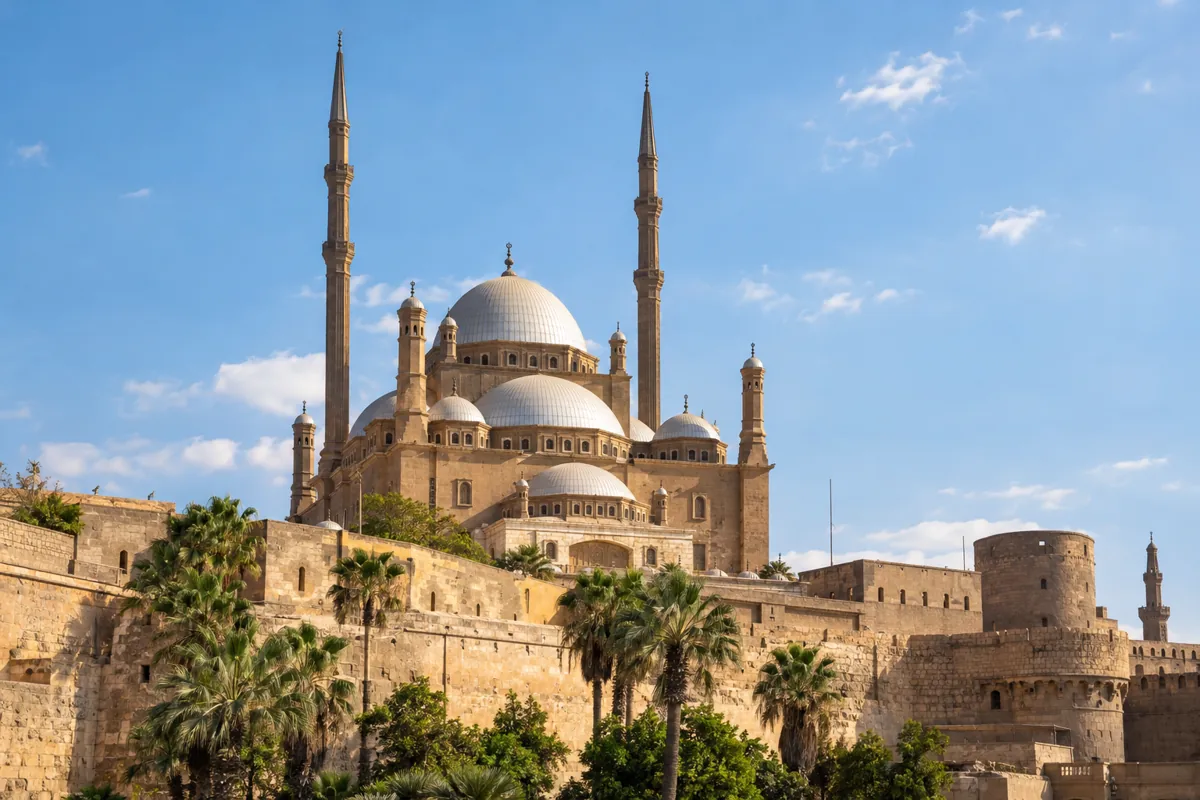
Mohamed Ali Mosque (the Alabaster Mosque): built in a distinctive Ottoman style and named for its alabaster wall facing — one of the most photographed landmarks in Cairo.
Al-Nasir Mohammed Mosque: another historic mosque within the Citadel walls, with Mamluk architecture entirely different from Mohamed Ali's.
The panoramic view: The elevated setting helps explain the city’s geography. Visibility and permitted viewpoints vary, and ordinary admission should not be assumed to allow sunset access.
Location: the Citadel sits on a hill in historic Cairo, close to other sites like the Sultan Hassan Mosque.
Tip: Plan for walking and check current site and building hours, last admission and access arrangements. Do not choose an arrival solely from sunset time.
Understand the Citadel before choosing a walking route
Cairo's Citadel is more than the setting of a famous mosque. It is a fortified complex whose buildings belong to different stages of the city's history. The Ministry's Citadel account places its beginning under Salah al-Din in 1176 and explains that construction continued beyond his lifetime. Its elevated position supported defence and later government. Reading the site as a changing complex helps you distinguish the original defensive purpose from the mosques and other buildings added afterwards.
That distinction gives a first-time visit a useful structure. Look at the enclosure and position, then at the buildings within it, and finally at the relationship with the city below. A photograph of the skyline captures one aspect but not the whole story. Choose a few elements to understand instead of treating every visible dome, wall and doorway as part of one project by one ruler.
Muhammad Ali Mosque: notice the plan as well as the skyline
The Mosque of Muhammad Ali is inside the Citadel and belongs to a much later period than its initial fortification. Its Ottoman-style arrangement includes a courtyard and a prayer hall organised around a central dome. The official mosque description explains the alabaster association through its wall facing; it should not be understood as a claim that the whole structure is made from alabaster.
As you visit, compare the open court with the enclosed hall. Notice how the view changes from a broad exterior outline to an interior defined by the dome, supports and light. You do not need a long list of technical terms to observe the difference. A good question for a guide is how the plan organises movement and attention, rather than simply asking which part makes the best photograph.
Do not confuse the different mosques inside the walls
The mosque of al-Nasir Muhammad ibn Qalawun is another part of the Citadel's layered history and belongs to the Mamluk context, unlike Muhammad Ali's later mosque. Identify each building by its own name rather than calling every mosque within the enclosure the Alabaster Mosque. If a particular interior is important to your visit, check that it can be entered on your chosen day before deciding the order of your route.
Comparing different buildings can make the visit more rewarding. Look at their relationship to the open space around them, the way a courtyard is framed and the treatment of entrances. You are observing differences, not trying to decide that one period is automatically better than another. A guide can explain the historical context and vocabulary if separately arranged; the transport driver should not be assumed to provide that service.
Plan around confirmed opening and last admission
Check current entry information for the Citadel and any specific building you intend to see. Do not assume that a general complex schedule applies to every interior, or that last admission leaves enough time for your entire plan. The official pages can distinguish the larger site and individual monuments. Reconfirm close to the visit, especially when the programme depends on one particular space or a fixed appointment later in the day.
Sunset photographs are not a reason to ignore visiting hours. A recommendation to arrive an hour before sunset can be impractical when the site or a building closes earlier. Choose a visit within confirmed access and treat the view available then as part of that experience. Never rely on a previous visitor's evening photograph as proof that the same access will be available on your date.
The view is part of the geography, not a guarantee of a photograph
The Citadel's elevated position offers a way to understand Cairo's relationship between older quarters, major monuments and the wider urban landscape. Take time to identify what you are looking at rather than relying on a caption that promises every landmark will be visible. Light, haze, weather and the permitted viewing position affect the scene. A planned panoramic stop can still be worthwhile without exactly reproducing a photograph taken on another day.
Keep photography within the allowed areas and avoid blocking narrow passages or climbing barriers for a different angle. If you want professional equipment or commercial filming, check permissions instead of assuming ordinary visitor admission covers the activity. For personal photographs, follow current signs and staff instructions. Set aside moments to look without the camera, especially when a crowded foreground makes an unobstructed image difficult.
Clothing, conduct and a comfortable visit
Prepare for both a historic site and religious spaces. Confirm clothing and entry requirements at the places you will enter, and follow instructions about shoes or behaviour where given. Avoid making a religious interior merely a backdrop for posed photographs. Quiet observation and consideration for other visitors let the group spend time understanding the building without interrupting the purpose or atmosphere of the space.
Wear footwear suitable for walking and discuss steps, slopes and walking limits with anyone who needs a more manageable route. Ask about current access arrangements for the actual areas you want to visit, not only whether the Citadel is generally accessible. A route can be suitable for one person and tiring for another. The plan should reflect the group's abilities, with a clear stopping point and time to return to collection.
Tickets and guiding are separate from getting there
Confirm the current ticket category and inclusions through the official information rather than copying an old fare from a travel post. A general admission arrangement does not automatically establish that every museum, special exhibition or activity is included. If you qualify for a visitor category requiring evidence, prepare the relevant identification. Keep the issued ticket or booking available independently of the vehicle reservation.
A private guide can help interpret the architecture and changing use of the complex. Confirm the language, meeting point and scope if you want one. A car and driver booking manages the agreed transport; it does not by itself include historical interpretation, admission or unrestricted access. Separating those services makes the quotation easier to understand and avoids arriving with an expectation that the driver will accompany the group through every building.
Combine nearby sites thoughtfully
A combined day can link the Citadel with a selected nearby destination, but the relationship on a map does not create a single entrance or ticket. Decide what you want to see at each stop and check its own access. Do not turn a nearby mosque, market or museum into an automatic extra simply because the vehicle passes near it. Entry procedures, walking and a proper break still require time.
For a history-focused programme, contrast the Citadel's fortified setting with one other kind of site rather than scheduling many similar-looking stops. If shopping is the second interest, a selected Khan el-Khalili walk needs its own collection point and realistic duration. Keep an optional stop genuinely optional so that the main visit does not become rushed if your group wants longer inside.
Organise the driver and collection before walking away
Agree a permitted drop-off and return meeting point and keep its location. Ask how to contact the driver when you are ready and how much notice is needed. Do not assume that the vehicle remains at the exact door where you entered or can follow the group through the complex. Tell the operator if anyone needs to minimise walking between the vehicle and the visitor route.
A direct transfer can suit a visit with a clear return arrangement, while an agreed car-and-driver period can support several stops. General Limousine's day allowances are eight hours with up to 120 kilometres or twelve hours with up to 150 kilometres, normally starting when the customer boards. Confirm waiting and extra use before booking. Those allowances do not constitute a base price for every Citadel itinerary or imply unlimited time at the site.
Citadel and Muhammad Ali Mosque questions
Are Saladin and Muhammad Ali connected with the same construction period?
No. The Citadel began as a medieval fortification, while Muhammad Ali's mosque was added much later. Distinguishing the periods is essential to understanding why the complex contains buildings with different functions and architectural character.
Can I plan the visit purely around sunset?
Only if the confirmed visitor arrangements allow the intended visit at that time. Do not assume evening access from a photograph or a general recommendation. Verify opening and last admission, then build the programme within them.
Is the whole mosque built from alabaster?
The familiar name relates to its facing and decoration, not a claim that every structural part is alabaster. Observe the materials and read the official description instead of interpreting the nickname literally.
Does the driver stay beside the entrance throughout?
Confirm the actual waiting and collection arrangement. Permitted vehicle access and parking may differ from the pedestrian route. Agree a recognisable point and communication process so that the end of the visit is as clear as its beginning.