
Choosing the wrong vehicle can make a trip uncomfortable, especially with family and a lot of luggage. Here's a quick way to get it right.
Sedan: Confirm the offered model’s suitability for passengers and bags together rather than assuming one capacity for the category.
SUV: Check the storage remaining with the required seats in use; the category name does not establish a fixed luggage capacity.
Mini van: Ask about the proposed seating layout, baggage space and requested child equipment.
Mini bus: Confirm the group arrangement, storage and boarding needs for the actual offered configuration.
The key rule: obtain confirmation that the offered vehicle suits the people, bags and equipment you have described.
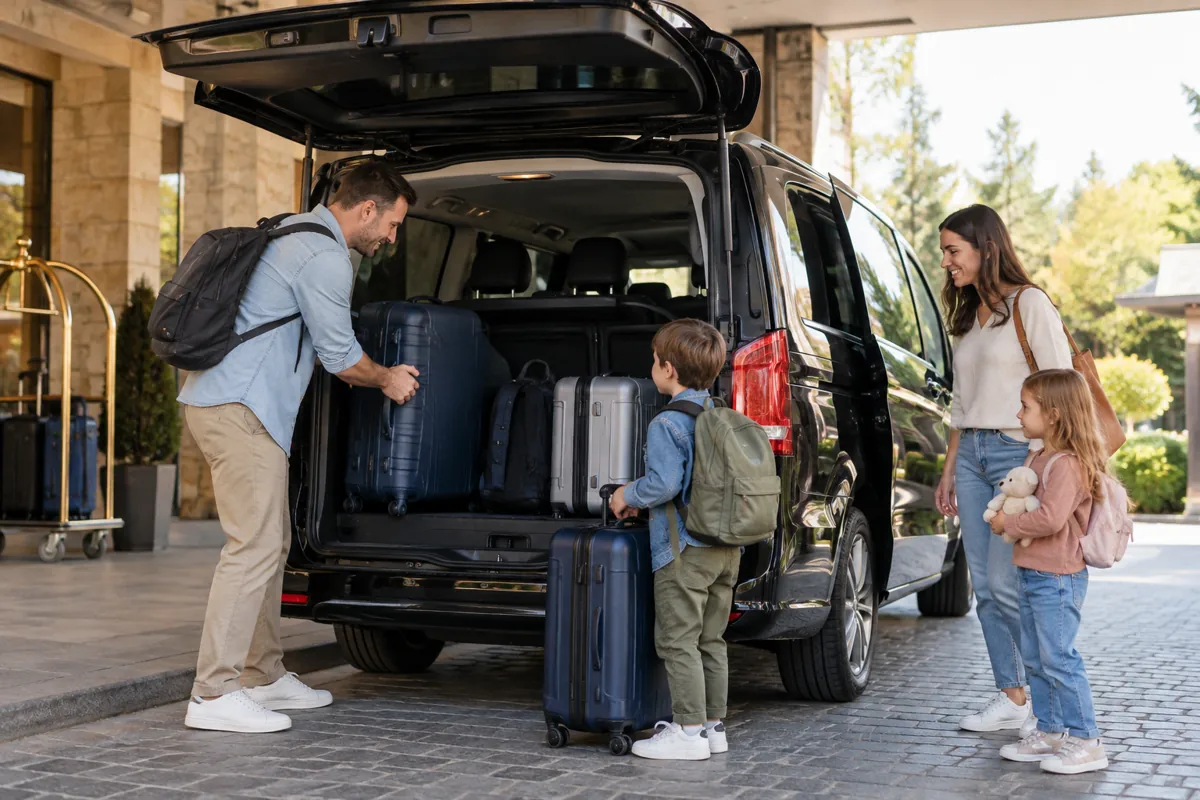
Start with the family and luggage, not the vehicle name
The right family transfer vehicle is the one that accommodates the actual people, bags and journey comfortably in its confirmed configuration. A category name such as sedan, SUV or minivan is only a starting point. Different models and seating layouts can have different luggage arrangements. Before choosing a category, write down how many adults and children will travel, what they are bringing and whether anyone has a particular boarding or mobility need. That information is more useful than simply asking for a large car.
Make a separate luggage list rather than counting everything as bags. Distinguish large suitcases, cabin cases, soft bags, a folded stroller and any unusually shaped equipment. If dimensions are important, send them or provide a clear photograph with measurements. A vehicle that works for a city journey with small personal bags may not work for the same passengers immediately after an international flight. The difference is the load, not the number of people alone.
Passenger capacity and usable luggage space are different questions
A published seating capacity does not establish the remaining storage space when every seat is occupied. Ask the provider to confirm the passenger and luggage combination together for the vehicle being offered. A folded or removed seat can change one capacity while reducing the other. Do not compare a photograph of an empty vehicle with your full-family arrangement and assume the same space remains available.
For example, four travellers with four large suitcases need a different assessment from four travellers with two small cases and a stroller. Neither combination has a universal answer based on the word SUV alone. State the actual load and request confirmation. If the provider proposes a different category, ask what practical requirement it resolves: storage volume, seating arrangement, easier entry or the need to keep the group together.
Children need a specific arrangement
Tell the operator that children are travelling and provide the information needed to discuss suitable restraints, including their ages and any relevant size requirements. Ask what equipment can actually be supplied and confirm it before travelling. The fact that a car has enough seats for the family does not answer whether the requested child equipment is available or how it will fit with the rest of the passengers.
If you intend to bring your own child seat, discuss its installation requirements and the space it occupies with the provider. Do not assume a requested extra is confirmed merely because it was mentioned in a message. Include it in the booking confirmation and check that the intended vehicle arrangement remains suitable. This is more useful than treating a larger vehicle as a substitute for the specific equipment your family needs.
Think through boarding and mobility requirements
For a traveller who finds steps difficult, vehicle height can matter as much as overall size. Ask about the actual boarding arrangement, door access and any assistance needed. If you are bringing a mobility aid, say whether it folds and provide its folded dimensions where relevant. A general description such as accessible vehicle may not explain whether the person can board, whether equipment fits or what assistance is available.
Consider the pickup and destination as well as the vehicle. A hotel entrance may allow convenient collection, while a walking district or restricted entrance may require a different meeting point. Explain any limit on walking distance before the quote is confirmed. The goal is a journey that works from doorway to meeting point and from vehicle to destination, rather than solving only the middle part on the road.
Airport transfers need flight and collection information
Provide the airport name, flight number and travel date, plus the final destination address. Cairo International Airport and Sphinx Airport are different locations. At Cairo International, check the terminal for the actual flight instead of relying on a fixed airline list. The scheduled landing time is not the same as the time the family will leave the building, especially when collecting several cases and preparing children to travel.
For General Limousine airport pickup, flight movements are monitored and up to two hours of waiting after landing are free. Additional airport waiting is EGP 100 per hour. Confirm the meeting arrangement for the terminal. At Terminal 2, the customer contacts the driver when coming out and identifies the gate so that the driver can approach; this should not be described as guaranteed waiting inside the building. The terminal guide explains the information to prepare.
Choose between a transfer and a family day with a driver
A transfer takes the family between agreed points. It can suit an arrival, a restaurant visit or a journey to one attraction when the return has been separately considered. A day with a driver can suit several stops, a flexible return and periods spent inside attractions. List the stops and tell the operator whether the family expects the vehicle to wait, rather than assuming that a hotel pickup automatically includes use for the rest of the day.
General Limousine's confirmed day packages are eight hours with up to 120 kilometres, or twelve hours with up to 150 kilometres. The normal starting point for time is when the customer boards. These limits help you compare a compact city programme with a longer itinerary. They do not include attraction admission, specialist guiding or activities unless those services are explicitly part of the confirmed arrangement. Read the day-hire details before selecting the package.
Budget for the programme, including possible extra use
For standard vehicles, the confirmed extra-use rates are EGP 150 per hour and EGP 20 per kilometre. HiAce and Coaster rates are EGP 200 per additional hour and EGP 25 per additional kilometre. An additional half-hour is charged as a full hour. Ask for the base amount for your actual vehicle and route; the existence of an allowance does not tell you the full price of a family day.
If your programme includes an airport pickup, a day package includes one such pickup, while a second airport service is charged separately. When waiting after landing extends beyond the two free hours, agree whether the package clock starts or waiting is handled separately before boarding. Keep that choice explicit. A clear quotation should explain the agreed journey and relevant limits, not leave the family to discover them when children are tired and plans have changed.
Build an itinerary the family can enjoy
Start with one main activity, then add a second stop only if it fits the group. Include time to enter, leave, use facilities and have a break. The map distance between attractions is not the whole visit. A day can become tiring because of repeated boarding, walking and queues even when the driving distance is modest. Ask which stop can be shortened or removed if the family needs more time at the first destination.
Keep essential items accessible without unpacking the whole luggage area at every stop. Tell the driver about any planned change before it affects collection, and use one family contact for coordination. If some members want to return early, treat that as a transport change to discuss rather than an automatic part of the original plan. Flexibility works best when the operator understands what is changing and can confirm the available arrangement.
One larger vehicle or two smaller ones?
Keeping the family together may simplify communication and arrival, but the answer depends on the confirmed load, route and availability. If two vehicles are needed, decide who travels in each and how luggage is divided. Give both drivers the correct destination and identify the contact for each group. Do not let an unplanned split separate a child from the responsible adult or leave essential equipment in the wrong vehicle.
Compare complete arrangements, not just category prices. Two quotations should cover the same passengers, luggage, journey times and stops. A cheaper option that omits the return or cannot confirm the requested equipment is not equivalent. Ask the provider to restate the final vehicle arrangement in writing after any change to the passenger count or baggage list.
Family vehicle booking questions
Can I choose using only the number of passengers?
No. Include luggage, child equipment and mobility requirements. Ask the operator to confirm that the combination fits the actual offered configuration. Nominal seats and usable storage need to be checked together.
Is an SUV always more suitable than a sedan?
Not automatically. Suitability depends on the model, seating, storage and boarding needs. Explain the requirement and compare the proposed arrangement rather than assuming that the category name guarantees more useful space.
Should I report a stroller as luggage?
Yes. Give its folded size and say whether it must remain easily accessible during the journey. Treat other bulky items in the same way so that the operator can assess the complete load before confirming the car.
What should the final confirmation contain?
Dates, pickup and destination, passenger and luggage details, requested equipment, the agreed vehicle arrangement, price scope and a reachable contact. For a multi-stop day, include the hours, kilometre allowance and return plan as well.